Introduction
Kia has lifted the veil on its next‑generation compact electric SUV, the 2026 Kia EV3. Positioned between the larger EV5 and EV9, the EV3 is meant to be a gateway model for drivers who want an electric vehicle that feels familiar yet unmistakably futuristic. The company has focused on a tighter package that still delivers the practicality and comfort expected of a Kia, while layering in the latest EV‑centric technology. From its sharper silhouette to its revamped cabin layout and a powertrain built for both city cruising and weekend road trips, the EV3 aims to be the most approachable electric SUV in Kia’s expanding portfolio.
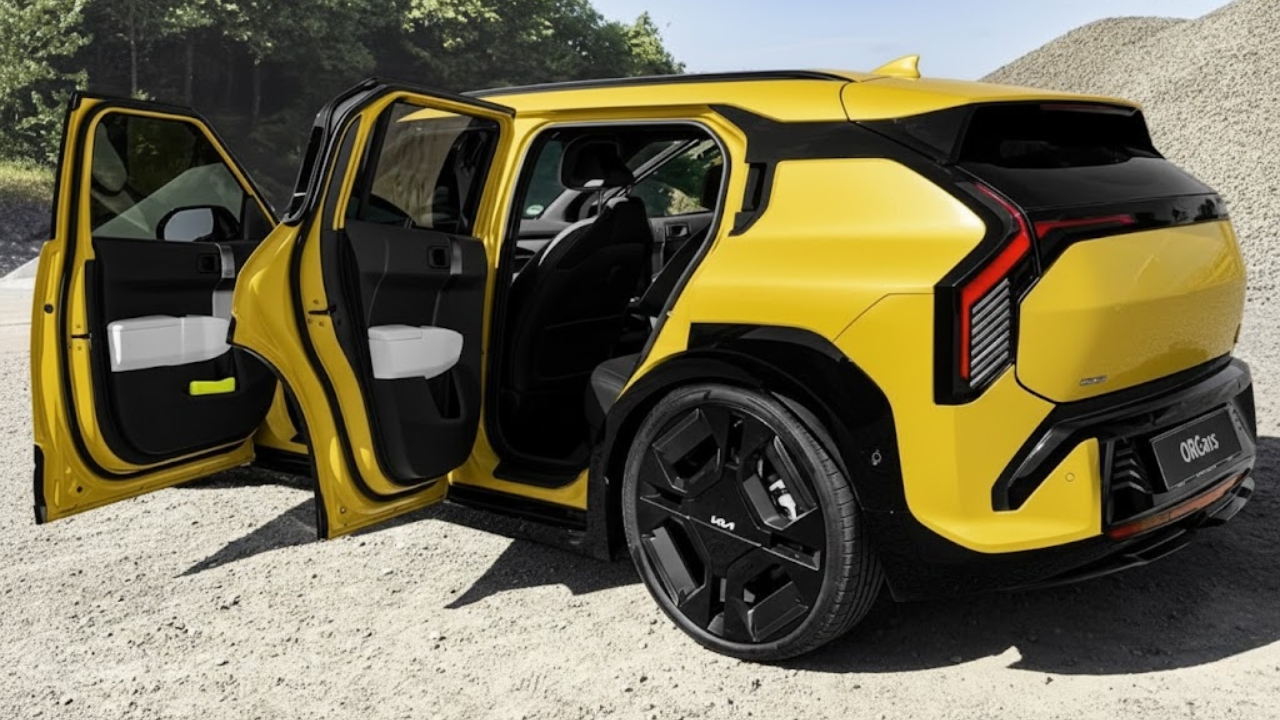
Exterior Design
The EV3’s exterior marks a clear shift toward a more athletic identity. The front fascia is dominated by a streamlined, closed‑panel “tiger‑face” grille that serves as an aerodynamic shield rather than a traditional intake. Angular LED headlights are paired with slender daytime‑running light strips that give the car a confident look even in low‑light conditions.

Side panels are sculpted with deep character lines that draw the eye along the length of the vehicle, emphasizing its compact but upright stance. The beltline rises gently toward the rear, creating a subtle sense of motion. Wheel arches are slightly flared, housing aerodynamic alloy wheels designed to reduce drag while improving brake cooling.
At the rear, a dual‑tone bumper adds visual width, and a slim LED light bar stretches across the tailgate, echoing the front’s lighting language. Optional features include a panoramic glass roof with a mild tint that enhances cabin ambience without compromising structural rigidity. Flush door handles and minimal overhangs further reinforce the EV3’s sleek, modern aesthetic.

Interior Layout and Materials
Step inside, and the EV3 presents a cabin that feels both spacious and purposeful. The dashboard has been stripped of unnecessary clutter, replaced by a clean, horizontal surface that houses a dual‑screen setup. The driver’s digital instrument cluster spans 12.3 inches, delivering real‑time energy data, while an 11.5‑inch central infotainment screen anchors the console.
Materials are a mix of soft‑touch plastics, recycled fabrics, and optional vegan‑leather upholstery, reflecting Kia’s push toward sustainability. The seats are ergonomically shaped, offering ample lumbar support for longer journeys. Rear‑seat passengers benefit from generous knee and headroom, and the bench can be folded flat to expand cargo capacity to a respectable 620 L when needed.

Ambient lighting is customizable with several color palettes, and the cabin’s climate control system uses heat‑reflective glass and insulated panels to keep the interior comfortable regardless of external temperature. Storage solutions are thoughtfully distributed: a large center console drawer, door pockets with soft‑close mechanisms, and a hidden nook beneath the front seats provide space for everyday items.
Infotainment and Connectivity
Kia has upgraded the EV3’s tech suite to keep pace with contemporary expectations. The infotainment platform runs a proprietary OS built on an Android base, ensuring fast boot times and fluid navigation. Wireless Apple CarPlay and Android Auto are standard, while a built‑in Wi‑Fi hotspot allows passengers to stay connected on the go.

Voice recognition has been refined to understand natural language commands, enabling drivers to adjust climate settings, set navigation destinations, or request music without taking their hands off the wheel. An AI‑driven charging planner analyses upcoming trips and suggests optimal charging stops based on real‑time grid data and station availability.
The vehicle also supports over‑the‑air (OTA) updates, meaning new features, map data, and performance tweaks can be delivered without a dealer visit. For rear passengers, a secondary entertainment screen can stream video content or serve as a gaming platform when the vehicle is stationary.

Powertrain Architecture
The 2026 EV3 will be offered with two powertrain configurations. The base model uses a single‑motor, front‑wheel‑drive setup delivering roughly 150 kW (200 hp) and 300 Nm of torque, adequate for urban commuting and highway cruising. The higher‑spec variant adds a second asynchronous motor to the rear axle, creating an all‑wheel‑drive system with a combined output near 230 kW (310 hp) and 400 Nm of torque.
Both versions share a modular 58 kWh lithium‑ion battery pack, positioned low in the floor to achieve a near‑ideal center of gravity. Kia claims a WLTP range of 430 km (267 mi) for the single‑motor and 410 km (255 mi) for the dual‑motor, thanks to optimized thermal management and regenerative braking that can be adjusted in four levels.

Charging is handled via a CCS‑2 port supporting up to 150 kW DC fast charging, allowing the battery to go from 10 % to 80 % in roughly 30 minutes. A Level‑2 AC charger (11 kW) can fully replenish the pack in about 5 hours, making home or workplace charging convenient for most owners.
Ride Comfort and Handling
Kia has tuned the EV3’s chassis to deliver a blend of composure and agility. The low‑mounted battery contributes to a low centre of gravity, which, when combined with a multi‑link rear suspension and MacPherson front struts, offers solid handling in tight city streets and stability at highway speeds.

Steering is electric‑assist with a relatively quick ratio, giving the driver precise feedback without being overly heavy. Ride modes—Comfort, Sport, and Eco—alter throttle response, regenerative braking strength, and suspension damping, allowing the driver to tailor the vehicle’s character to the situation.
Noise, vibration, and harshness (NVH) levels are kept to a minimum through acoustic glass, sound‑absorbing insulation, and the inherent quietness of an electric drivetrain. The result is an interior that feels serene even at higher speeds.

Safety Systems
The EV3 is built on Kia’s latest safety architecture, incorporating a high‑strength steel frame plus strategically placed aluminum reinforcement zones to protect occupants and the battery pack. Standard driver‑assistance features include:
- Adaptive Cruise Control with stop‑and‑go capability
- Lane Keeping Assist with lane‑centering functionality
- Forward Collision‑Avoidance with pedestrian and cyclist detection
- Blind‑Spot Monitoring with rear‑cross‑traffic alert
- 360° surround‑view camera system for low‑speed maneuvering
Kia’s “Smart City Brake Support” can autonomously apply the brakes at speeds up to 30 km/h (19 mph) if an imminent collision is detected. Additionally, a rear‑mounted automatic emergency braking system helps mitigate rear‑impact accidents. All safety hardware is designed to be future‑proof, ready to receive OTA updates that may add new algorithms or enhancements.

Practicality for Daily Life
Despite its futuristic styling, the EV3 remains a practical choice for everyday use. The compact dimensions (approx. 4,400 mm length, 1,800 mm width) make parking in tight urban spots effortless, while the turning circle of 10.5 m facilitates navigating narrow streets.
Interior space is maximized through a flat floor and a sloping rear hatch that opens wide for easy loading. With the rear seats folded, the cargo volume expands to more than 600 L, sufficient for weekend luggage, sports gear, or a full grocery haul. Numerous 12‑V power outlets, USB‑C ports, and a wireless charging pad add convenience for tech‑savvy occupants.

Pricing and Market Availability
While Kia has not disclosed exact pricing, analysts anticipate the EV3 will sit between $32,000 and $38,000 USD for the base single‑motor model, with the dual‑motor variant adding roughly $5,000–$7,000. Incentives, such as federal tax credits and regional rebate programs, could further lower the effective purchase price.
Production is slated to begin at Kia’s Gwangju plant in South Korea during the first half of 2026, with initial deliveries targeting the Korean domestic market, Europe, and North America. Kia plans to offer optional equipment packages that bundle premium interior trims, fast‑charging accessories, and advanced driver‑assistance suites.
Final Thoughts
The 2026 Kia EV3 represents a thoughtful evolution of Kia’s electric strategy. It blends an athletic exterior, a well‑crafted and tech‑rich interior, and a powertrain that balances range with performance—all while keeping pricing within reach of many first‑time EV buyers. The vehicle’s combination of practicality, safety, and modern conveniences positions it as a strong contender in the increasingly crowded compact electric SUV segment. If Kia can deliver on the promised specifications and maintain a reliable charging network partnership, the EV3 could become a cornerstone model for the brand’s growth in electrified mobility.
Frequently Asked Questions
1. How long does it take to fully charge the EV3 on a fast charger?
Using a 150 kW DC fast charger, the EV3 can charge from 10 % to 80 % in about 30 minutes. A full charge from 0 % to 100 % will take roughly 45 minutes under optimal conditions.
2. Is the EV3 eligible for federal EV tax credits in the United States?
Yes, the EV3 qualifies for the current federal tax credit of up to $7,500, assuming the vehicle’s battery capacity and the manufacturer’s sales volume meet the required thresholds.
3. What warranty coverage does Kia offer for the battery?
Kia provides an 8‑year / 100,000‑mile warranty on the battery pack, guaranteeing it will retain at least 70 % of its original capacity during that period.
4. Can I install a home charger for the EV3, and what power level is recommended?
A Level‑2 home charger (7–11 kW) is recommended for daily overnight charging. Kia sells an optional Wall‑Connect charger that’s compatible with the EV3’s CCS‑2 inlet.
5. Does the EV3 support vehicle‑to‑grid (V2G) or vehicle‑to‑home (V2H) functions?
The initial launch will focus on standard charging and regenerative braking. Kia has indicated that V2G/V2H capabilities could be introduced via future OTA updates, subject to market demand and regulatory approval.
Disclaimer
The information presented in this article is based on publicly available data, manufacturer announcements, and industry speculation as of December 2025. Specifications, pricing, availability, and features are subject to change before the official launch of the 2026 Kia EV3. Readers should verify details with an authorized Kia dealer or the company’s official communications before making any purchasing decisions.